
July 10, 2017
In 2016, Chicago suffered a record-breaking 764 homicides, becoming the eighth-most violent city in the United States. In certain neighborhoods, the homicide rate soared past 130 per 100,000 – more than Caracas, Venezuela; more than Acapulco, Mexico; more than Tegucigalpa, Honduras, where ASJ (formerly known as AJS) works.
“Honduras is a country of 8 million people; Chicago is a city of 8 million people,” noted Pastor Ray Carter, who serves with the Chicago Fellowship, a nonprofit organization and Bible study designed for business leaders in the city. “If you looked at the problems and challenges there and compared them to the problems and challenges we face in our city, there are a lot of similarities.”
These similarities have led to a partnership between the Chicago Fellowship and ASJ. “The minute I met Kurt and saw what ASJ was doing,” said Carter, “I saw that doing justice was going to be facilitated and made possible through the experience and partnership with ASJ.”
Several years ago, the two groups began to share their experience and expertise. On a trip to Chicago, Ver Beek spoke at a meeting of the business leaders. The following year, several members of the fellowship visited the ASJ office to consult about expansion and learn more details about ASJ programs.
During both visits, Ver Beek encouraged the group to think more systemically about violence in their own neighborhoods.
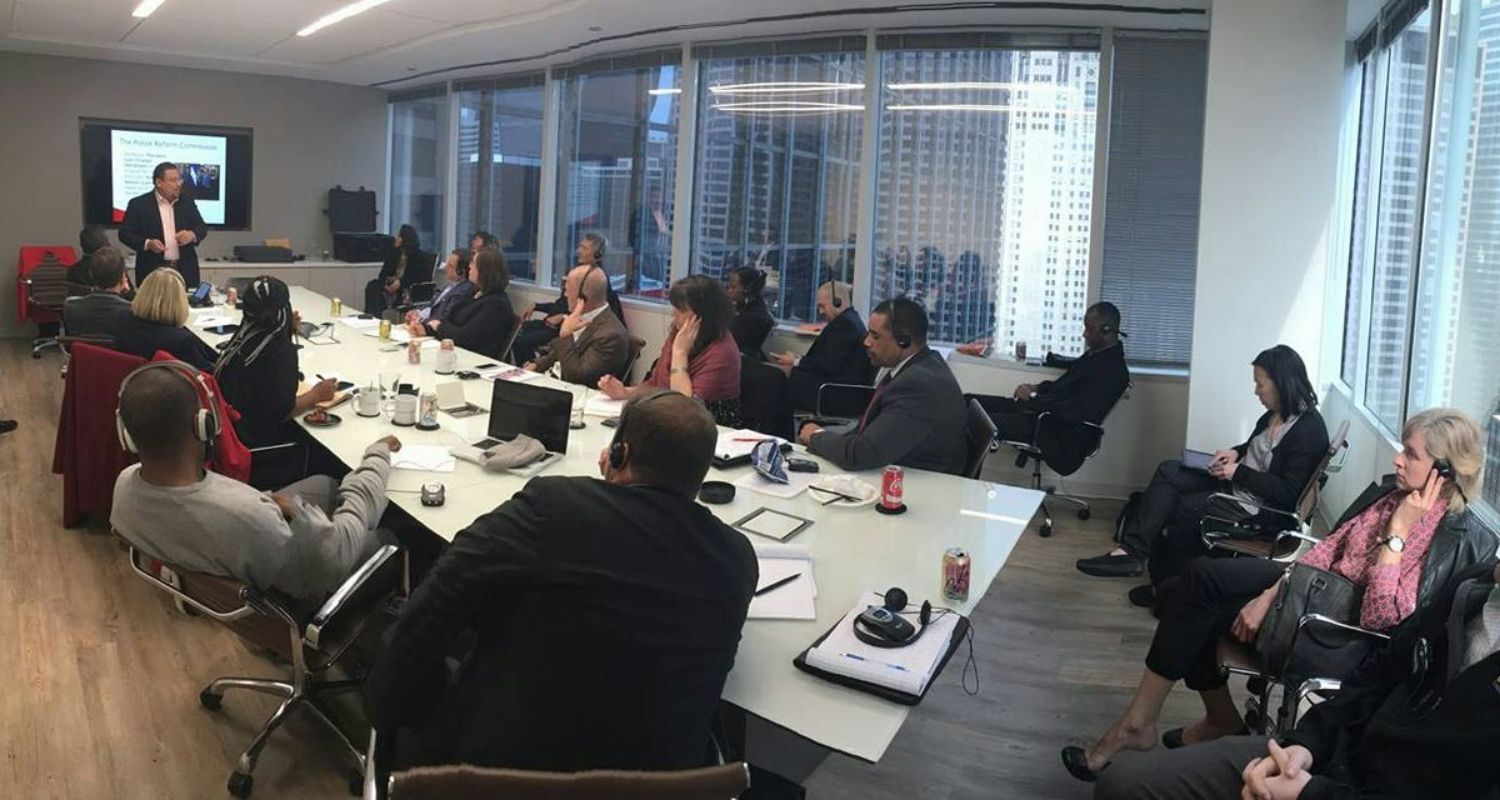
This past April, the Chicago Fellowship and ASJ came together in Chicago for an Anti-Violence Summit where leaders from Honduras and Chicago could brainstorm and dream together. Kurt Ver Beek, along with member of the police reform commission Omar Rivera, presented ASJ’s justice theory and framework to a room of leaders from Chicago nonprofits, churches, foundations, and activism groups.
“It was a fruitful discussion,” said Carter. “We talked about these broad principles – speaking truth to power, building consensus, getting more people to understand that this is a problem.”
“There were fundamental principles that ASJ was discovering to be critical and important in combating violence,” said Carter, pointing in particular to “breakdowns of trust in government and law enforcement.”
Kurt Ver Beek also saw a clear parallel between Honduras’ high homicide rates, and Chicago’s alarming violence. “Nobody trusts the police,” he says, “but also the police don’t trust the community. Police don’t know the community”.
The exact reasons for this breakdown in trust may differ – for example, Honduras doesn’t have the same fraught history of racial discrimination as Chicago – but the results are the same. Fewer people report crimes. Impunity leads to greater numbers of crimes. And cycles of violence continue.
For Ver Beek, a big part of the meeting was helping the group believe that this sort of change was possible.
“That was the message that kept coming through,” he said: “You can do this. If this can happen in Honduras, it can happen in Chicago. If we can bring organizations together around these issues in Honduras, you certainly can in Chicago. If we can see change on a community level, you certainly can in Chicago.”
Beyond specific strategies to respond to violence, ASJ staff laid down a challenge.
“Maybe at some point it was okay for society to hand over these topics to our mayors and our police, but now many of us are learning that we can’t do that. It’s not enough to elect people every four years and then sit back and go about our business,” says Ver Beek.
“Many people just complain – it’s too big of a problem, it’s too complicated,” he said,
“But we need to engage around topics like violence, education, and health care, we need to get involved. And if the message from Honduras is anything, it’s that we can learn about these things, we can change these things. It’s not as hard as we think.”
“After this meeting we can say, ‘look at where Honduras was when ASJ started, the level of corruption in the government and the total breakdown in trust” said Carter, “You can think that Chicago is hopeless, but you also would have said that Honduras is hopeless, and look at the change we are seeing today.”