November 30, 2018
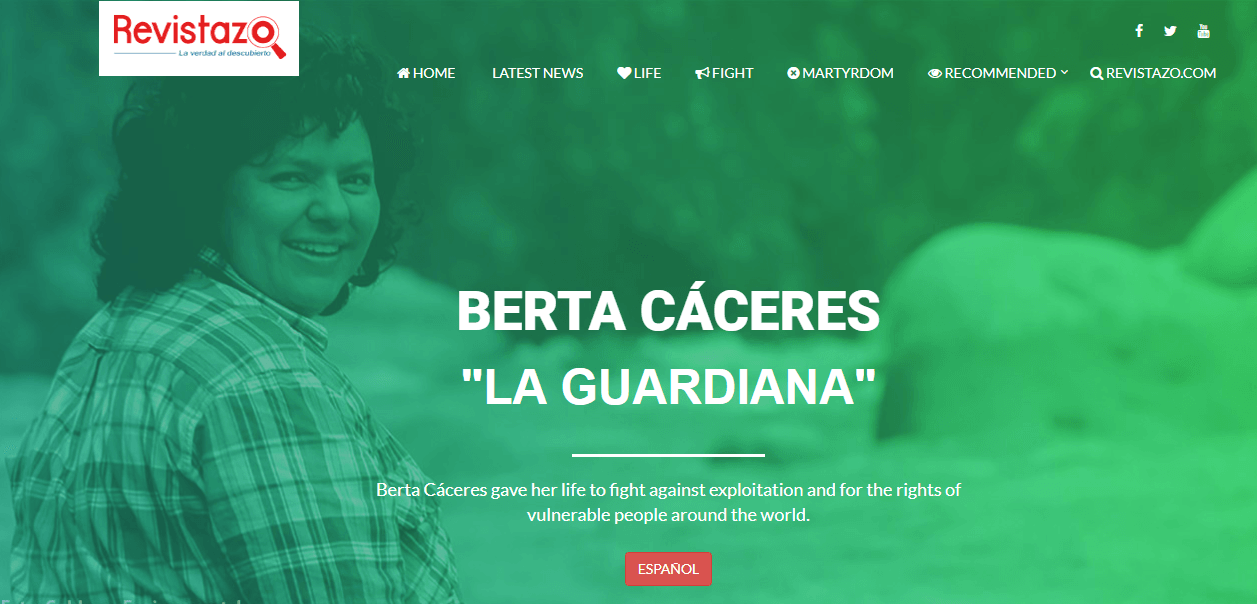
This article was originally published on laguardiana.revistazo.com, a project of Revistazo, ASJ-Honduras’ alternative journalism website. Visit the English version of the site for more about Berta Cáceres’ life, her cause, and the trial against those who murdered her.
It was late at night on March 2, 2016, when Berta Cáceres, renowned Honduran activist, said goodnight to her houseguest. She and Gustavo Castro, an environmentalist from Mexico, had been running a workshop all day and had stayed up late to get more work done
Berta walked down the hall and turned left into her bedroom. Her small green house sat in the neighborhood El Líbano, nestled against the hills on the outskirts of La Esperanza, a colonial town in western Honduras. For most of her life, Berta had lived with her mother. But with the mounting threats in the past year, Berta had decided, just a couple of months earlier, that it was safer for her mother if Berta moved out on her own.
Castro stayed up a little longer working in bed in the guestroom. Sometime after 11:30 p.m., he heard a noise outside. Someone was walking around the perimeter of the house.
Berta heard the footsteps too. Castro heard her call out, “Who’s there?”’
Then a loud bang sounded in the kitchen as the back door came crashing in. Within seconds, a man was standing in the doorway of the guest bedroom holding a gun. A second man rushed pashed him and headed down the hall toward Berta’s room.
THE ROAD TO MURDER
At 7:51 a.m. that morning, four men met together in La Ceiba, a beach town on Honduras’ Caribbean coast, according to telephone data analyzed by the International Advisory Group of Experts (GAIPE, by its Spanish acronym). The group was comprised of Oscar Torres; Elvin Rápalo, a construction worker and experienced assassin; Edilson Duarte Meza, a former infantry captain; and Henry Hernández, a former sergeant in the armed forces and the leader of the crew.
Within the next year, all four men would be arrested for the murder of Berta Caceres.
The group set out together on the six-hour drive to La Esperanza. On the road, Hernández placed a couple of phone calls to Douglas Bustillo, a former army lietenant who through 2015 had served as chief of security for DESA, an energy company.
Berta, who was known as “the guardian of the rivers”, had been a fierce protestor of DESA and the hydroelectric dam that the company was building on the Gualcarque River in a rural region with a large indigenous population about 25 miles north of La Esperanza. As the director of COPINH, an indigenous and environmental rights organization, Berta and fellow activists opposed the dam that had invaded the space without consulting the local indigenous population, as stipulated in Honduran law through the ILO Convention 169.
Supporters of COPINH and members of the local communities had blocked the roads to the dam’s construction site in April of 2013, after DESA continued to build the dam without completing the consultation. Multiple clashes had transpired between the community members and the company’s employees. Berta had filed complaints with the government alleging that the dam and 41 other energy projects had violated indigenous rights.
Soon after filing this complaint, Berta began to receive death threats. Due to the gravity of the threats, the Inter-American Court of Human Rights (IACHR) granted Berta precautionary measures with which gave her the right to constant protection by the Honduran government.
For a few weeks, Bustillo and Hernández had been visiting La Esperanza and keeping tabs on the movements of Berta and other COPINH members with the help of Sergio Rodríguez, DESA’s environmental engineer. Text messages, published by GAIPE, show detailed accounts of the activists’ activities that were sent between DESA directors and employees starting in May of 2015. Rodríguez sent a message the day before the murder noting the movements of COPINH members after a workshop.
Just before 4:00 p.m. on March 2, the group of men arrived in La Esperanza. They would leave the city at 11:38 p.m. that night.
MURDER
Six shots rang out from Berta’s bedroom. The man standing before Castro pointed his gun at Castro’s head and pulled the trigger. Castro dove to the floor. One bullet hit his left ear and another grazed his shoulder.
He lay still until he heard the man walk out of the room, and then heard both gunmen rush out of the house through the backdoor they had entered through.
When he heard them leave, Castro got to his feet and went to Berta’s room. He found her bleeding on the floor. She asked him to call for help. Minutes later, Berta died in his arms.
According to the GAIPE report, the autopsy reported three bullet wounds in Berta’s chest. Police found two other bullets in the back wall of the bedroom and one in the doorframe of the bathroom to the left of the bed.
Back on the road, Hernández made another phone call to Bustillo. He called Bustillo twice more in the next hour.
THE MORNING AFTER
At 4:00 a.m., Berta’s brother, Gustavo Cáceres, was startled awake by the sound of the phone ringing. He picked it up and heard the shaky voice of his mother.
“She said that they killed Bertita and asked me to find out for sure,” remembers Cáceres, his eyes red with tears. “I said, ‘It can’t be true.’”
A friend and politician from Tegucigalpa had somehow gotten ahold of the news and had contacted Berta’s mother.
The family arrived at Berta’s house shortly after and found her body still lying on the bedroom floor. According to Berta’s daughter, Olivia Zuniga, the house was filled with police. With all of the people moving in and out, Berta’s mother says that she suspected that the crime scene had already been tampered with.
The Minister of Security made a public statement early in the morning. He claimed that the murder was a crime of passion, suggesting that an ex-lover of Berta had tried to kill her and Castro.
“Even a Minister of Security, a public official, can say such things,” says Zuniga. “It was six in the morning when he was giving these statements, and my mother’s body still had not been taken away from the crime scene. I can say that because I was there. Yet, he dared to say it was a crime of passion.”
Zuniga claims that someone at the crime scene snuck a pair of Berta’s underwear into Castro’s backpack to corroborate the minister’s story.
In his statements, the Minister of Security, Julián Pacheco, also responded to the issue of the protective measures that, according to the Inter-American Human Rights Commission, the Honduran Government was supposed to be providing to Berta. He stated that Berta had denied the constant police protection, but a police officer did patrol her movements in her hometown. He claimed that the lack of protection on that fatal night had been due to an error in her registered address.
Contrary to the minister’s account, Berta’s mother claims that the police did know where Berta lived, and that they patrolled her neighborhood every night.
“They did their rounds at nine with a patrol car, but they did not pass by that night,” she tells Revistazo.
MURDER CHARGES
As of the time this article was published, nine men have been charged with the murder of Berta Cáceres. Five were arrested in Operation Jaguar on May 2, 2016, two months after the assassination. Those five included Bustillo, Rodríguez, Duarte, Duarte’s twin brother Emerson Duarte, and Major Mariano Díaz Chavez, a military intelligence officer who served in the 15th Battalion with Hernández.
Emerson Duarte was arrested after the murder weapon was discovered in his home. The writers of the GAIPE report, however, state that they found no evidence for his involvement in the crime other than his relation to one of the other suspects.
Rápalo was arrested in September of that year, and Hernández and Torres were captured in January and February of 2017, respectively, nearly a year after the assassination took place.
Those eight men all faced trial in 2017. However, the Public Prosecutor’s Office failed to share its investigation and evidence with the private prosecuting attorneys representing Berta’s family. (In Honduras’ legal system, private accusers may represent victims and work alongside public prosecutors in criminal prosecutions.) The lack of cooperation made it difficult for the attorneys to proceed with their arguments, and the trials were delayed multiple times.
Currently, four of the accused—Hernández, Edilson Duarte, Emerson Duarte, and Torres—are still awaiting a preliminary hearing. On June 13th, a judge declared that the case of the other four suspects—Bustillo, Rodríguez, Rápalo, and Chavez—would go on to a Public Trial.
Believing that the assassination orders came from higher up in DESA’s socially, economically, and politically powerful administration, national and international activists and media have heavily criticized the case for the lack of arrests of an intellectual author
Then, on March 2, 2018, on the two-year anniversary of the murder, the Public Prosecutor’s Office announced the arrest of DESA’s president, Roberto David Castillo.
Castillo is now awaiting trial. His arrest has brought some hope that the assassination of Honduras’s guardian of the rivers will come to justice.
On November 29th, the Honduran Attorney General’s office announced the convictions of seven of the eight men initially charged with the murder of Berta Cáceres. For more on this ongoing story, follow the latest news on “Berta Cáceres: The Guardian”.