
February 22, 2017
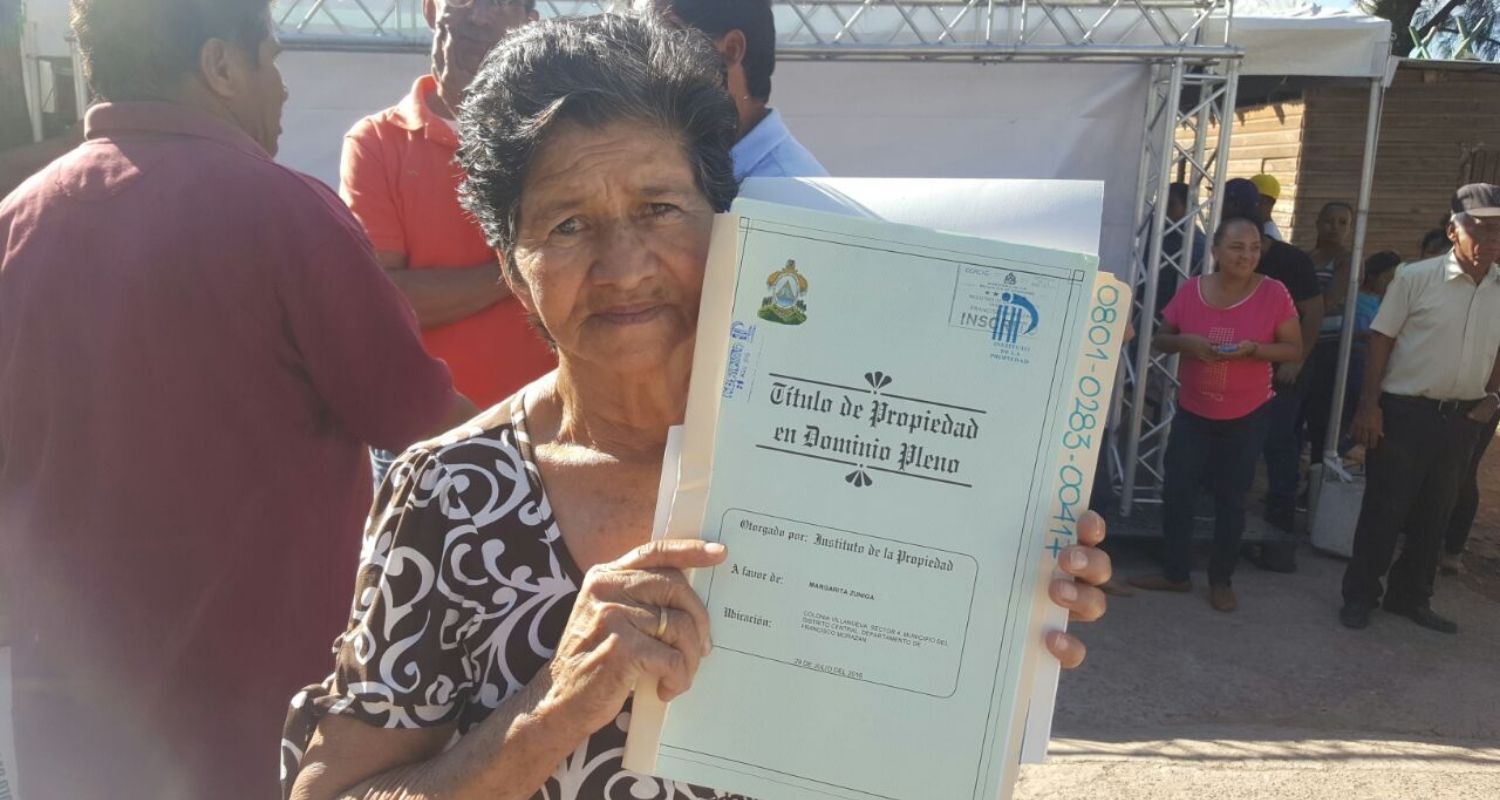
Margarita Zúniga has lived in her community of Tegucigalpa, Honduras for 32 years, raising five children, and now many grandchildren in her cement-block home.
Years after she had moved into the land and constructed a house, government officials came to her saying she had to pay for her property. Though she only made a few dollars a day washing and ironing clothes, she began to make small but regular payments. After years, she had paid off her land – but never got the promised title.
“That was 15 years ago,” she said. “They said I had to pay a lawyers, I had to go here, I had to go there, and I went and I went.” After so many dead ends, however, she had almost given up.
In Honduras, over the last few decades, a slow internal migration has seen hundreds of thousands of people move from their rural lives as subsistence farmers, to the cities. In the 1980s, thousands moved to informal settlements, building their homes on hills with no roads, no water, and no legal recognition. As the communities grew, so did land conflicts.
Though Honduran law allows for the legalization and registration of settlements where individuals have lived for over ten years, few people were aware of this, or of how to do carry out that process. This left many thousands of Hondurans vulnerable to losing their land in a legal battle they could neither understand nor afford.
In 1998, the Association for a More Just Society (ASJ, formerly known as AJS) began with a land rights project, working in communities to help people register their land. They walked alongside people through the labyrinthine processes, through multiple agencies, with multiple people, processes that could take years.
The more they became involved with the Property Institute, the government institution which manages land registration and titling, the more ASJ believed that the institution could, and should be better.
Focusing on individual cases, they found, can win individual victories – but it doesn’t help to rewrite a broken system.
“We had been focused at the community level, making sure that people got their titles, but we weren’t looking at the titles themselves,” said Anajansi Alvarado, a land titling expert with ASJ. “We were seeing titles with names misspelled, or with missing information that invalidated the titles.”
ASJ was making progress in teaching communities how the land titling process should work – but found that weakness within the Property Institute meant that reality looked much different.
“The population can know all the laws,” said Alvarado, “But if the laws aren’t followed, it doesn’t do any good.”
The Honduran Property Institute has long suffered from a combination of corruption and incompetence. Bureaucrats with no legal or property-related experience mismanaged processes, leaving ample opportunity for corruption and bribery.
So ASJ shifted their focus, advocating directly to the government for reforms in the way land titles were registered and delivered.
ASJ’s land rights team audited thousands of titles prepared in 2014, and found that every single one contained an errors. Furthermore, they revealed a lack of digital backup of land titles, meaning that if the paper title was lost, individuals may be forced to re-start the entire titling process.
The next year, despite some improvements, a third of titles were still flawed. On top of this, land registration was so backed up that a process that should have taken ten months was taking, on average, six years.
But ASJ’s constant advocacy is beginning to see results. After a 2015 baseline study showed the Property Institute scoring a dismal 19% in compliance with transparency standards, the director of the Institute sat down with ASJ to create a measurable improvement plan.
With the support of ASJ, the Property Institute has defined specific, measurable goals, something they have never before tracked. Now they will be held accountable to process 10,000 titles every year – a small dent in the estimated 80% of Honduran land that lacks titles, but a significant one nonetheless.
By the end of 2016, it became clear that for the first time the Property Institute had met their goal, processing 10,005 land titles. Even better, at the beginning of November, ASJ audited nearly 1,000 titles and found zero errors.
Now, in public events across Honduras, titles are being given out that ASJ trusts are well-prepared and accurate.
What’s more, things are beginning to change within the institution itself.
“When we look from last year to this year, we see significant changes,” said Alvarado, “Now, employees start each day with a stack of titles – they have to have these done by the end of the day or explain why not. Before, there was no control, no one was monitored, documents could easily be lost. Now we’re using a manual that institutionalizes processes.”
“We have received a great deal of support from them (ASJ),” said Marcela Maldonado, director of property registration at the Property Institute. “We have implemented quality controls, and they also accompanied us with the creation of our first process manual for property regularization, and this has helped us to be able to deliver legal and quality titles.”
At a public event delivering land titles, the President of Honduras phoned in with his own words of recognition.
“It is very important to secure the property you have through a title, because that permits a series of opportunities, such as, for example credit, or to have the peace and calmness of something that is yours,” said President Juan Orlando Hernández.
“I want to congratulate the Property Institute, and the people of ASJ for their support so this process could be transparent as it should be.”
The changes over the last few years are making a real difference for thousands of Hondurans still waiting for title to their land.
Julian Castro was born in his community, but until he received his land title, he had no proof that the house where his parents had raised him belonged to his family. He worked for two years alongside the community board to apply for his property.
“For me it means everything,” he said, “There’s a great joy that we have something that’s ours, that we can give to our children, and that no one can take away from us.”
Eusedia López has lived in her home for 20 years, “We give thanks to God,” she said, “We have been waiting for so long, this is an old community. This is proof that something belongs to us,”
And Margarita Zúniga, who had paid for her home 15 years ago, was relieved and proud to finally hold proof in her hands, knowing that she would have something concrete to leave for her daughters.
To her, the title is proof that she is the owner of her home. “I know that I have it there,” she continued, “that I worked hard for it, and that it’s mine.”