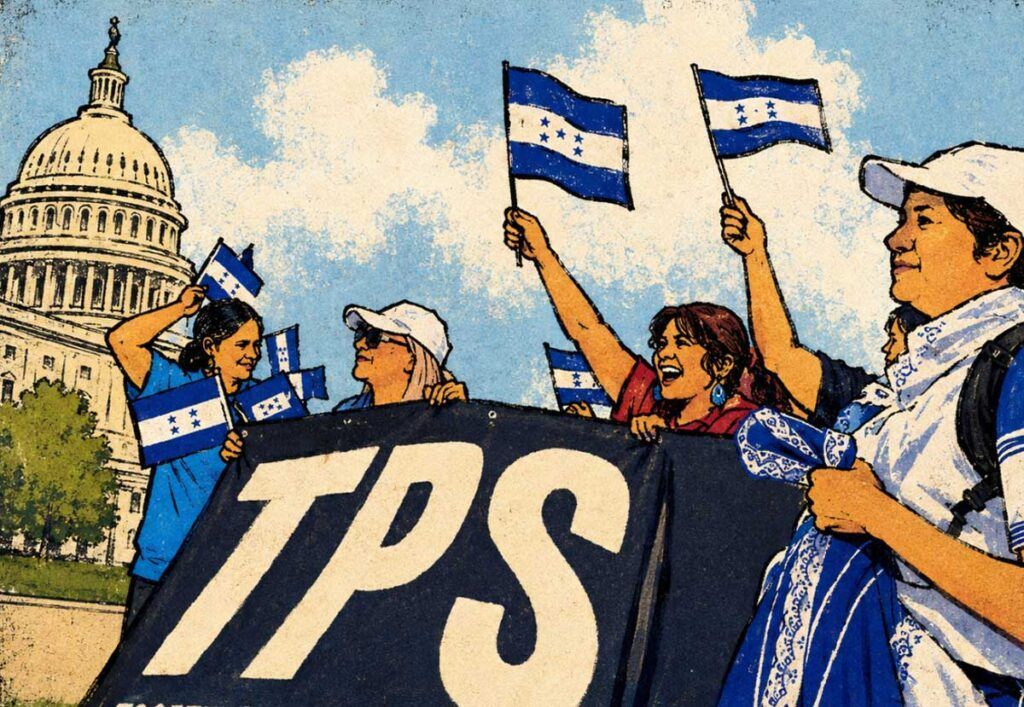
The definitive termination of Temporary Protected Status—canceled by the United States as of September 8, 2025, and confirmed by the Honduran Ministry of Foreign Affairs on August 18, 2026—means that more than 54,300 Hondurans have lost the immigration protection that allowed them to live and work in the United States. Furthermore, they face the possibility of being deported if they remain in the country. What until recently was a threat on the horizon is now a reality unfolding before our eyes, forcing Honduras to answer a question that has been postponed for years: Will Honduras continue to depend on remittances, or will it finally invest in domestic production?
For more than 10 years, Honduras has become a country that relies heavily on remittances, to the extent that for every dollar entering the country from exports, two dollars come in from remittances; and when it comes to Foreign Direct Investment, the ratio increases to 10 to 1. By 2026, remittances are projected to total approximately US$13 billion; essentially, this is the main source of income that sustains the country’s trade balance (our ability to continue paying for imported goods, medications, clothing, food, etc.). According to data from the Permanent Household Survey[1], approximately 670,000 Honduran households receive remittances, and 62% receive them monthly. Furthermore, the Semi-Annual Survey of Family Remittances[2]
shows that for 45% of households[3], this is their primary source of income.
Meanwhile, Honduran TPS holders sent an average of between US$160 million and US$210 million annually[4], a figure that illustrates the significance of this group within the broader flow of family remittances and indicates that the current situation is no minor matter, both for the inflow of foreign currency into the country and for the individual income and well-being of the households receiving these remittances from their relatives protected under TPS.
With regard to the territorial dimension, data from the Central Bank of Honduras (BCH) show that the departments of Francisco Morazán and Cortés receive the largest regular flow of remittances, ranging from US$377 million to US$512 million, which raises a major concern: remittances are not only a source of supplemental income in departments where the productive and labor market structure forces people to seek better opportunities by migrating to the United States, but they also supplement income in “developed” urban centers where, in theory, there are more formal jobs.
Another significant—and equally concerning—fact is that nearly 80% of households that receive remittances use this money to finance daily expenses (living expenses, medicine, education, debt repayment); of these, only 4% save, and barely 3% invest in businesses or real estate. In other words, the country has received an exceptional inflow of foreign currency that has not been used for capital accumulation and investment but rather to keep the country barely afloat. This can also be confirmed by the fact that the main recipients of remittances are the migrant’s close relatives (40% mother, 18% siblings, 11% children or father, 7% spouse, and 3% grandparents).
This pattern resembles what economic literature describes as “Dutch disease,” although instead of an oil or mining boom, the flow distorting the economy is that of remittances. The mechanism is well known: a sustained inflow of foreign currency, unrelated to domestic productivity, tends to appreciate the real exchange rate, reduces the incentive to export, sustains consumption without requiring a productive counterpart, and stifles the rest of the productive sector.
Honduras has lived with this dynamic without naming it: while remittances sustained the consumption of hundreds of thousands of households, investment in productive capacity, formal employment, and competitive wages lagged behind. The result is an economy that depends on another country absorbing its labor force, rather than generating the jobs that labor force needs domestically.
The end of TPS is not just an immigration issue; it is a direct test of that dependence. Tens of thousands of Hondurans who were working in the United States—many of them heads of households whose monthly remittances were the primary source of income for an entire family—are returning to a Honduran labor market that was not designed to absorb them. The question is not just how many are returning, but under what conditions the country can receive them: Are there formal jobs available? Are wages comparable to the remittances they used to send? Is there the productive infrastructure to integrate them with dignity?
The honest answer is that not yet—and even less so when considering other social factors (family separation, depending on citizenship) and psychological factors (returning to a country very different from the one they knew when they left, one that is more insecure and politically unstable, etc.). That is why the underlying challenge is not palliative (legal guidance, temporary job placement programs, seed capital) but structural; Honduras needs to invest decisively in expanding its productive capacities, in sectors capable of generating formal, well-paid, and sustainable employment that can absorb both the current population and those returning.
Remittances allowed Honduras to stay afloat for years; the end of TPS may mark the beginning of the end of that illusion. What the country does—or fails to do—now will determine whether this crisis becomes the catalyst for actions that transform the country into a more productive economy or yet another social crisis mitigated by the government’s welfare policies, as has been the case on other occasions.
Footnotes:
- Own estimate based on data from the 2025 EPHPM (INE, 2025)
- Results of the Semiannual Survey on Family Remittances (BCH, 2025)
- Approximately 301,500, based on the estimate using data from the EPHPM
- TPS Honduras: The Impact of Its Cancellation (NODO, 2025)